HTML Accessibility Checks
Quarto includes integrated support for axe-core, a broadly-supported, open source, industry standard tool for accessibility checks in HTML documents.
Interactive accessibility checks
To enable the simplest form of accessibility checks, add the axe YAML metadata configuration to HTML formats (html, dashboard, and revealjs):
format:
  html:
    axe: true
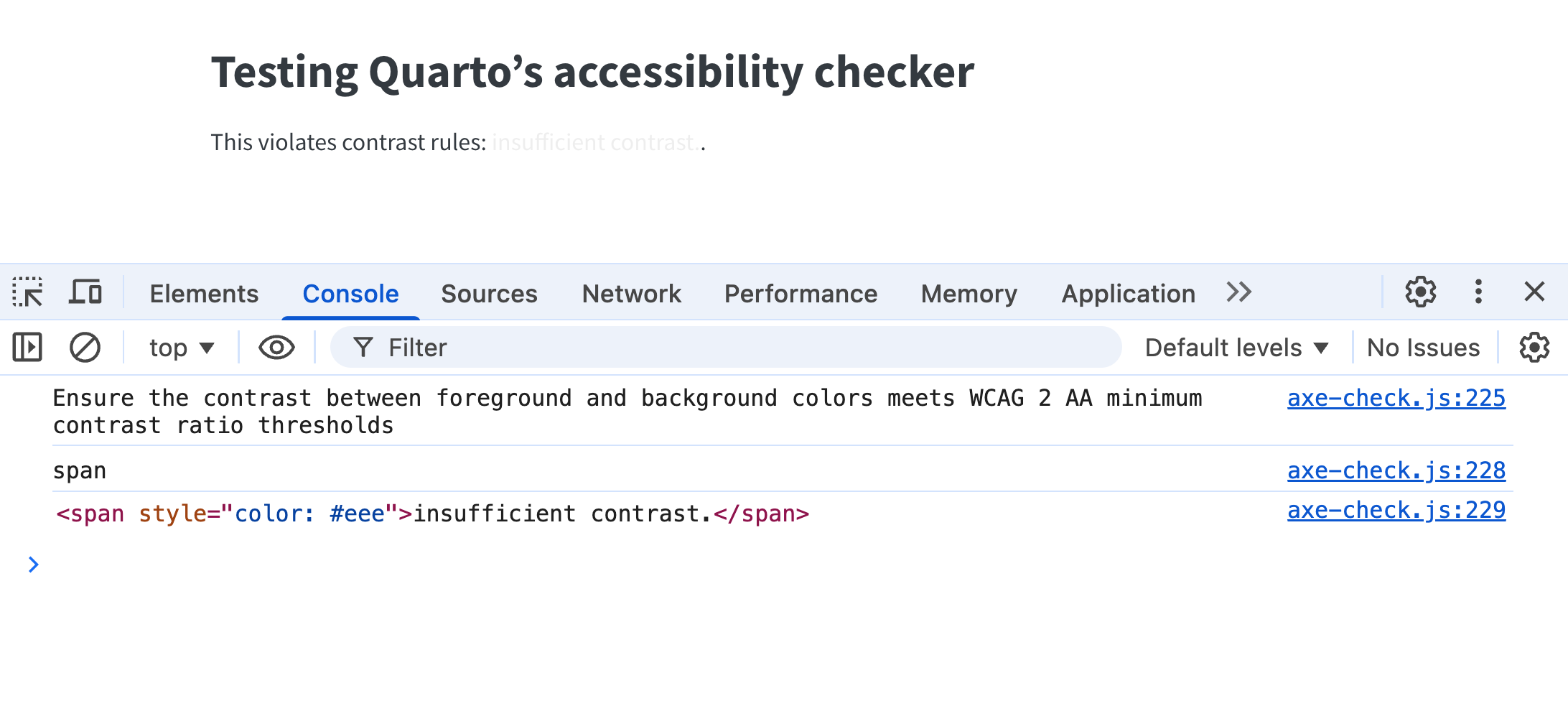
Render and open the document in a browser. Accessibility violations will be visible as console messages in your browser’s development tools.
For example, this document contains a color contrast violation:
---
title: Testing Quarto's accessibility checker
format:
  html:
    axe: true
---

This violates contrast rules: [insufficient contrast.]{style="color: #eee"}.
---
title: Testing Quarto's accessibility checker
format:
html:
axe: true
---
This violates contrast rules: [insufficient contrast.]{style="color: #111"}.Previewing the rendered page and opening the browser’s developer tools shows the violation axe-core found:
Output location
Quarto supports three output formats for the accessibility checks, available through the output option.
document: embedded reportsformat: html: axe: output: documentWith this option, Quarto will generate a visible report of
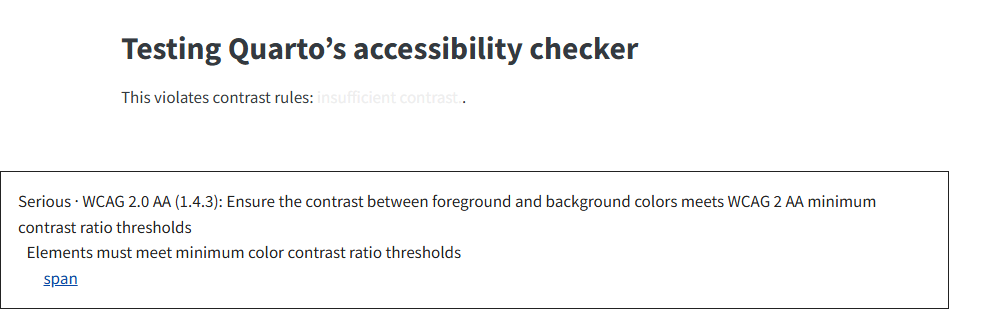
axe-coreviolations on the webpage itself. Each violation displays its WCAG conformance level (e.g.,WCAG 2.0 AA), so best-practice findings are distinguishable from genuine WCAG failures. This is useful for visual inspection of a page. Note that with this setting, Quarto will always produce a report.If you wish to use this feature, we recommend adding it to a “debug” project profile to reduce the chance you will accidentally publish a website to production with these reports.
json: JSON-formatted console outputformat: html: axe: output: jsonThis option is useful if you’re comfortable with browser automation tools such as Puppeteer and Playwright, since it produces output to the console in a format that can be easily consumed.
Specifically, the JSON object produced is the result of running
axe-core’srunmethod on the webpage. We defer toaxe-core’s documentation for full information on that object.consoleformat: html: axe: output: consoleThis option is equivalent to
axe: true.
For the example above, output: document places the report on the page itself:
Checking against a WCAG conformance level
By default, axe-core runs its full default rule set, which combines rules for several WCAG versions and levels with axe’s own “best practice” rules. If you are working toward a specific WCAG conformance level, use the standard option to check only the rules for that level:
format:
  html:
    axe:
      standard: wcag21aa
The available values name a WCAG version followed by a level: wcag2a, wcag2aa, wcag2aaa, wcag21a, wcag21aa, wcag21aaa, wcag22a, wcag22aa, and wcag22aaa. Each standard is cumulative — it includes the rules for the lower levels and earlier versions it builds on. For example, standard: wcag21aa checks the rules for WCAG 2.0 A, 2.0 AA, 2.1 A, and 2.1 AA.
For the full list of rules, grouped by these same WCAG versions and levels, see axe-core’s rule descriptions.
When you specify standard Axe’s best-practice rules are excluded. To check them alongside a standard, add best-practice: true:
format:
  html:
    axe:
      standard: wcag21aa
      best-practice: true
You can also exclude the best-practice rules without choosing a standard by setting best-practice: false on its own.
Site-wide accessibility checks
The checks above are interactive: they require opening each page in a local preview and inspecting the results in the browser.
In the future, we envision a mode where every page of a website can be checked at the time of quarto render or quarto publish in order to reduce the amount of required manual intervention.